Previous Safety Score Versions
Depending on your state, you may currently be enrolled in a previous version of Safety Score. Find your version below for additional details.
-
What Changed in Version 2.2
Safety Score Beta version 2.2 has a more accurate assessment of your future collision risk based on over 22 billion miles of driving data. The key changes from version 2.1 to version 2.2 are:
- Excessive Speeding is now measured as a proportion of driving time in excess of 85 mph or speeding in relation to the vehicle in front of you.
Note: Availability of Safety Factors will vary based on your Tesla vehicle’s Infotainment system and Self-Driving hardware. Feature availability depends on vehicle configuration, hardware, software version, region, model, vehicle trim and model year.
Safety Factors
There are several Safety Factors that impact your Safety Score. These are measured directly by your Tesla vehicle by using the software and various sensors on the vehicle.
Note: Feature availability depends on vehicle configuration, hardware, software version, region, model, vehicle trim and model year.
Determining Your Safety Score
In order to calculate your daily Safety Score, we use the Predicted Collision Frequency (PCF) formula below to predict how many collisions may occur per 1 million miles driven, based on driving behaviors measured by your Tesla vehicle. Driving with Traffic-Aware Cruise Control (TACC), Autosteer or FSD (Supervised) engaged (including 5 seconds after TACC, Autosteer or FSD (Supervised) is disengaged) will not be factored into the Safety Score Beta formula.
Predicted Collision Frequency (PCF) = 0.57198191
x 1.23599110Hard Braking
x 1.01219290Aggressive Turning
x 1.00271921Unsafe Following Time
x 1.32343362Forced Autosteer or FSD (Supervised) Disengagement
x 1.03231810Late-Night Driving
x 1.02439511Excessive Speeding
x 1.01151237Unbuckled Driving
The current formula was derived based on statistical modeling using over 22 billion miles of fleet data. We expect to make further changes to the formula in the future as we gain more customer and data insights.
The PCF is converted into a 0 to 100 Safety Score using the following formula:
Safety Score = 122.15240383 - 38.72920381 x PCF
Your daily Safety Score is not impacted by the number of miles you drive. We combine your daily Safety Scores (up to 30 days) into an average, weighted by miles driven while TACC, Autosteer or FSD (Supervised) is disengaged to calculate the aggregated Safety Score, which is displayed on the main ‘Safety Score’ screen of the Tesla app.
Note: Since Tesla vehicles with hardware older than computer 2.0 do not measure following distance, Unsafe Following Time is replaced by a default value of 21.8% in the PCF formula. For these vehicles, the value of 122.15240383 is replaced by 123.50230309 in the Safety Score Beta formula.
Improving Your Safety Score
You can improve your Safety Score by improving each Safety Factor.
Hard Braking
Engage the brake pedal early when slowing down, coming to a stop or reacting to a change in your environment. Use regenerative braking whenever possible and safe to do so. Maintaining a safe following distance reduces the instances where the brake pedal needs to be applied with extreme force.
Aggressive Turning
When turning, changing lanes or rounding a corner, do so gradually. Reduce your speed heading into a turn, gradually accelerating out of the turn. Do not unnecessarily jerk the steering wheel.
Unsafe Following
Do not tailgate or drive close to the vehicle in front. Maintain a following distance of several car-lengths to the vehicle in front to have sufficient time to react to its speed. Remember that driving at higher speeds in inclement weather or on slick road surfaces requires a greater following distance to allow sufficient time to react safely.
Excessive Speeding
Plan a little extra time when commuting so you can arrive on time without driving over 85 mph or significantly exceeding the speed of the vehicles around you. Traveling at high speed or much faster than surrounding traffic adds additional risk when driving. Always maintain a safe and consistent speed and pay attention to the other vehicles on the road, especially in traffic-congested areas, to help reduce potential risk and improve your Safety Score.
Late-Night Driving
Plan your trips to avoid driving between the hours of 11 PM and 4 AM to help reduce the likelihood of a dangerous driving environment.
Forced Autosteer or FSD (Supervised) Disengagement
Only use the various features as described in your Tesla Owner’s Manual. Pay attention to the road and maintain your hands on the steering wheel while the Self-Driving system is engaged.
Note: Feature availability depends on vehicle configuration, hardware, software version, region, model, vehicle trim and model year.
Unbuckled Driving
Build a habit of fastening your seatbelt in the driver’s seat before you shift out of park. Even at slow speeds, wearing your seatbelt is an easy way to help reduce risk while driving and avoid serious injury.
Frequently Asked Questions
What’s required for me to get a Safety Score for my Tesla vehicle?
When available for your Tesla vehicle, you will see ‘Safety Score’ on the home screen of the Tesla app. To receive a Safety Score:
- Your vehicle must be on software update 2025.2.6 or later (2021.24.25 or later for Tegra vehicles) or be enrolled in Full Self-Driving (Supervised) version 13.2.8 or later. To check the latest software version on your vehicle, tap ‘Software’ on your touchscreen.
- Your vehicle must be connected to a cellular or Wi-Fi network.
- You need to take a trip that’s at least 0.1 miles on your vehicle.
Will I receive a Safety Score if I don’t have connectivity?
If your Tesla vehicle does not have cellular connectivity while on a trip, you may not receive immediate feedback upon the end of your trip. You will receive your updated driving information and Safety Score once your vehicle has connectivity. Premium Connectivity is not required to receive a Safety Score.
How often will my Safety Score be updated?
In order to provide you real-time feedback on your driving safety, every time you take a trip in your Tesla vehicle, your Safety Score for that day will be updated. At the end of each day, your Safety Score for that day will no longer change — any subsequent trips will be used to determine your Safety Score for the following days.
In the event that you do not have cellular connectivity, you may not receive immediate feedback upon the end of your trip. You will receive your updated driving information once you have connectivity.
When will I be upgraded to the latest version of Safety Score Beta?
If you are insured by Tesla Insurance in any state other than California, you will be upgraded to the latest version of the Safety Score Beta at the time of your policy renewal. Review the table below to determine your next renewal date depending on your state and compare that with the starting date for the latest version of Safety Score Beta. If your next policy renewal date is effective on or after the new Safety Score Beta version starting date, then you will be moved the newest version of Safety Score Beta at the time of your policy renewal.
State Safety Score v2.2 Starting On Renewal Effective On or After Arizona April 1, 2025 June 15, 2025 Colorado April 1, 2025 May 31, 2025 Illinois April 1, 2025 May 31, 2025 Maryland April 1, 2025 June 15, 2025 Minnesota April 1, 2025 May 31, 2025 Ohio April 1, 2025 May 31, 2025 Oregon April 1, 2025 May 31, 2025 Texas April 1, 2025 May 31, 2025 Utah April 1, 2025 May 31, 2025 Virginia April 1, 2025 May 31, 2025 Nevada Coming soon Coming soon Note: If you are being upgraded, we will send you a notice approximately two months before your next renewal date.
Is all my driving captured?
Tesla captures driving over all trips, where a trip consists of any driving (including reversing and Traffic-Aware Cruise Control (TACC), Autosteer or FSD (Supervised) usage) occurring between the time the Tesla vehicle is powered on and able to be driven to the time the vehicle is powered off. Any driving and accrued mileage occurring while in service mode is excluded. Trips less than 0.1 miles will be excluded from scoring calculations. Driving while TACC, Autosteer or FSD (Supervised) is engaged (including 5 seconds after TACC, Autosteer or FSD (Supervised) is disengaged) will not be factored into the Safety Score Beta formula.
I had a Safety Factor event (such as hard braking) while Traffic-Aware Cruise Control (TACC), Autosteer or FSD (Supervised) was engaged. Will my Safety Score be impacted?
Your Safety Score is weighted by miles driven while TACC, Autosteer or FSD (Supervised) is disengaged, excluding five seconds after TACC, Autosteer or FSD (Supervised) is disengaged. This does not include Forced Autosteer or FSD (Supervised) Disengagements or Late-Night Driving, which will impact your Safety Score. Any events that occur while a driver is manually engaging the acceleration pedal while on Traffic Aware Cruise Control will count towards the Safety Score.
My Trip View shows an event during a time when Traffic-Aware Cruise Control (TACC), Autosteer or FSD (Supervised) was engaged. Is this a mistake?
Events that happen during times when TACC, Autosteer or FSD (Supervised) is engaged are not counted towards your Safety Score, unless you override Traffic Aware Cruise Control with the accelerator pedal. These events will appear in your trip timeline view. The event will show “Acceleration Override” next to the time in the list of events.
How are different hours weighed by Late-Night Driving?
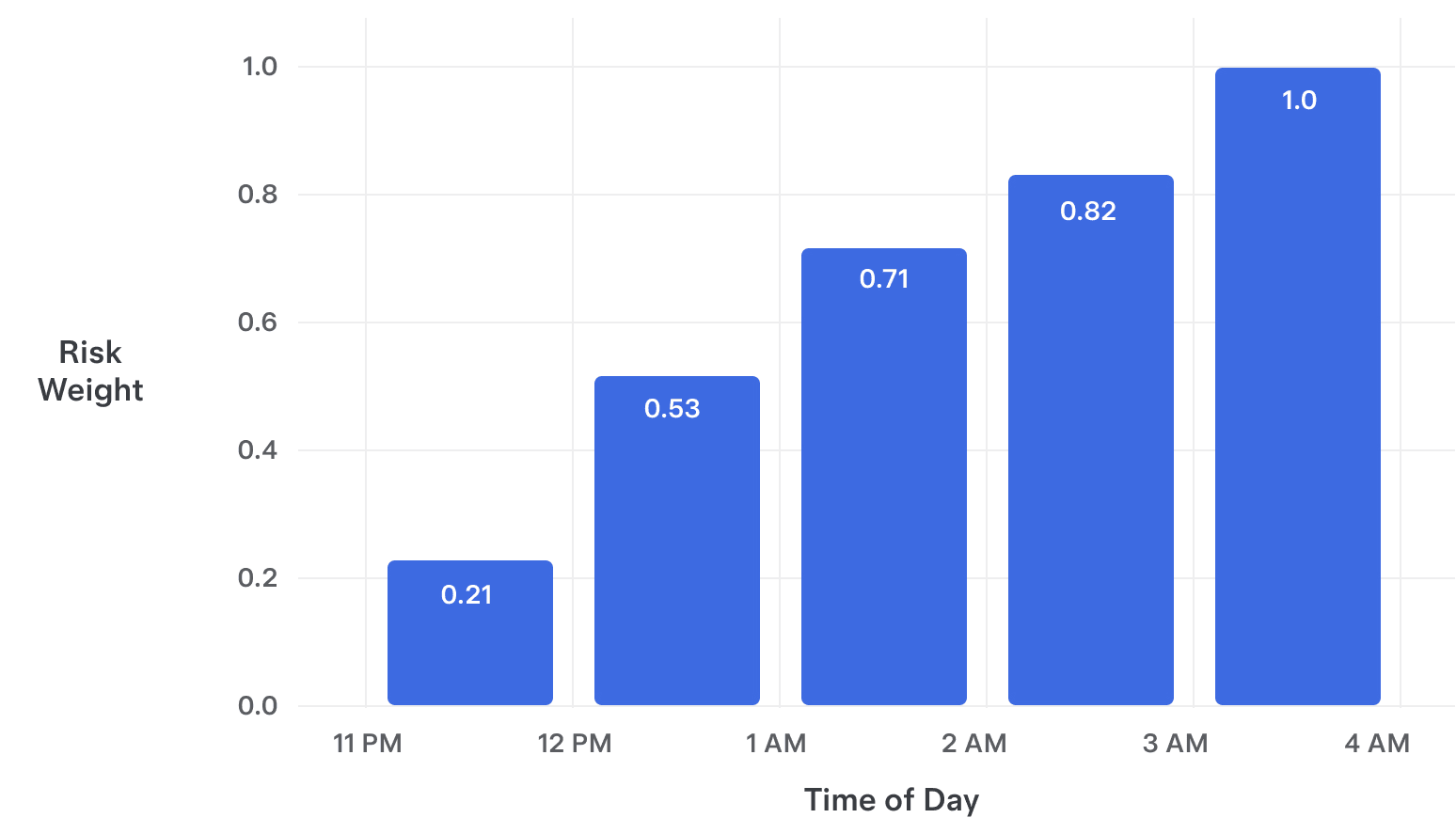
In Safety Score Beta version 2.2, Late-Night Driving hours are weighed differently to better reflect the amount of risk associated with driving at those times. The following table illustrates how each hour from 11 PM – 4 AM is weighed in the Safety Score Beta formula:
The final contribution of your late-night driving to your Safety Score is calculated as:
Late-Night Driving = Risk Weighted Late-Night Driving (seconds) / Total driving time (seconds)
Where Risk Weighted Late-Night Driving (seconds) is defined as:
0.21090 x Driving time between 11 PM and 12 AM (seconds) +
0.53235 x Driving time between 12 AM and 1 AM (seconds) +
0.70849 x Driving time between 1 AM and 2 AM (seconds) +
0.82031 x Driving time between 2 AM and 3 AM (seconds) +
1.00000 x Driving time between 3 AM and 4 AM (seconds)
How are time changes handled with Late-Night Driving?
Times on trips are based on the time zone of the vehicle at the end of the trip. When a Daylight Savings time change occurs during your trip, the amount of Late-Night Driving time is the amount of time you drove during the hours of 11 PM and 4 AM. This means that during the Spring and Fall time changes, we do not count the addition of an extra hour or removal of an hour due to Daylight Savings time.
Why was my Safety Score impacted when I was braking for a yellow traffic light?
Your Tesla vehicle relies on its cameras and firmware to detect yellow traffic lights. It may not detect all yellow traffic lights. Examples of situations that could lead to undetected yellow traffic lights include when the cameras are obscured or do not have line of sight of the traffic signals, inclement weather, or low light environments.
Yellow traffic light detection is only available on vehicles with Full Self-Driving computer 3.0 or later.
How will I know that I have experienced an event that would contribute to my Safety Factors and Safety Score?
Your Tesla vehicle provides you with a range of safety features that include warnings and alerts to help protect you, your passengers, other drivers and pedestrians around you. View the Owner’s Manual for specific details about the various safety features in your vehicle.
Review the following to learn more about how an event contributes to each Safety Factor:
- Hard Braking
No audio or visual alerts are provided if you brake with excessive force. In some cases, the anti-lock braking system (ABS) which prevents the wheels from locking when you apply maximum brake pressure, may be activated, and you will see the ABS alert. If you apply the brakes with extreme force, you may feel like you are being pulled forward into your seatbelt, away from the seat. - Aggressive Turning
No audio or visual alerts are provided if you turn with excessive force. If you take a turn with extreme force, you may feel the sensation of being pulled away from the direction you are turning. - Unsafe Following Time
Your Tesla vehicle does not provide you with any audio or visual alerts when you are following at an unsafe following distance. You may receive an alert if your following distance makes collision with the vehicle in front likely. - Excessing Speeding
Your Tesla vehicle displays the vehicle’s speed which can be used to determine when you are driving over 85 mph or 20% faster than the vehicle in front of you, when that vehicle is driving at least 25 mph and within 100 meters. No separate audio or visual alerts are provided if you drive over 85 mph or 20% faster than the vehicle in front of you. - Late-Night Driving
Your Tesla vehicle displays the vehicle’s local time which can be used to determine when you are driving between 11 PM and 4 AM. No separate audio or visual alerts are provided if you drive within these hours. - Forced Autosteer or FSD (Supervised) Disengagement
Your Tesla vehicle will provide three audio and visual warnings before the Self-Driving system is disengaged due to inattentiveness. Refer to the Owner’s Manual in your vehicle for details of these alerts and the circumstances in which the Self-Driving system will disengage. - Unbuckled Driving
Your Tesla vehicle displays the vehicle’s speed which can be used to determine if you are driving over 10 mph without wearing your seatbelt. Your vehicle will provide an audio alert if you are driving without buckling your seatbelt. There are no audio or visual alerts to specifically indicate if you’re driving over 10 mph without buckling the driver’s seatbelt.
How does my Safety Score work if I have more than one vehicle?
Your Safety Score is vehicle specific. If you have more than one Tesla vehicle, each one of your Tesla vehicles will have its own Safety Score.
What happens to my Safety Score if I sell my vehicle?
If the vehicle ownership changes, the Safety Score Beta data previously collected will neither be used for the vehicle under the new owner, nor will it be used for a new Tesla vehicle you purchase.
How will driving more on Traffic-Aware Cruise Control (TACC), Autosteer or FSD (Supervised) impact my Safety Score?
On any given day, your Safety Score is primarily based on your driving activity when TACC, Autosteer or FSD (Supervised) are disengaged. If most of your driving on a given day is with TACC, Autosteer or FSD (Supervised), your Safety Score will likely be lower, as only a small portion of that day’s driving was without TACC, Autosteer or FSD (Supervised) engaged. While your Safety Score for that day may be low, the weighted average Safety Score that is used to determine your insurance premium is weighted by miles driven while not using TACC, Autosteer or FSD (Supervised). Since those miles are low on this hypothetical day, this day will not have a significant impact on your average score.
Note: Feature availability depends on vehicle configuration, hardware, software version, region, model, vehicle trim and model year.
-
What Changed in Version 2.1
Safety Score Beta version 2.1 has a more accurate assessment of your future collision risk based on over 30 billion miles of driving data. The key changes from version 2.0 to version 2.1 are:
- Updated Late-Night Driving to be risk weighted based on driving from 11 PM – 4 AM (previously 10 PM to 4 AM). The impact of late-night driving on your Safety Score will depend on the proportion of time spent driving in each hour from 11 PM – 4 AM.
Note: Availability of Safety Factors will vary based on your Tesla vehicle’s Infotainment hardware.
Safety Factors
There are several Safety Factors that impact your Safety Score. These are measured directly by your Tesla vehicle using various sensors on the vehicle and Self-Driving software.
Determining Your Safety Score
In order to calculate your daily Safety Score, we use the Predicted Collision Frequency (PCF) formula below to predict how many collisions may occur per 1 million miles driven, based on driving behaviors measured by your Tesla vehicle. Driving on Autosteer (including 5 seconds after Autosteer is disengaged) will not be factored into the Safety Score Beta formula, but the miles driven while on Autosteer are included in the total.
Predicted Collision Frequency (PCF) = 0.50243837
x 1.00890677Forward Collision Warnings per 1,000 Non-Autosteer Miles
x 1.18282601Hard Braking
x 1.01997156Aggressive Turning
x 1.00431643Unsafe Following Time
x 1.26582521Forced Autosteer Disengagement
x 1.06088826Late-Night Driving
x 1.00449763Excessive Speeding
x 1.01500342Unbuckled Driving
The current formula was derived based on statistical modeling using over 30 billion miles of fleet data. We expect to make further changes to the formula in the future as we gain more customer and data insights.
The PCF is converted into a 0 to 100 Safety Score using the following formula:
Safety Score = 113.96245249 - 27.78938322 x PCF
Your daily Safety Score is not impacted by the number of miles you drive. We combine your daily Safety Scores (up to 30 days) into a mileage-weighted average to calculate the aggregated Safety Score, which is displayed on the main ‘Safety Score’ screen of the Tesla app.
Note: Since Tesla vehicles with hardware older than computer 2.0 do not measure following distance, Forward Collisions Warnings per 1,000 non-Autosteer miles and Unsafe Following Time is replaced by default values of 15.6 and 21.6% in the PCF formula, respectively. For these vehicles, the value of 113.96245249 is replaced by 108.43874088 in the Safety Score Beta formula.
Improving Your Safety Score
You can improve your Safety Score by improving each Safety Factor.
Forward Collision Warnings per 1,000 Non-Autosteer Miles
Maintain a safe following distance from the vehicle in front to give you enough time to react to slower or stationary vehicles. Pay attention to the other vehicles on the road and reduce speed in traffic congested areas.
Hard Braking
Engage the brake pedal early when slowing down, coming to a stop or reacting to a change in your environment. Use regenerative braking whenever possible and safe to do so. Maintaining a safe following distance reduces the instances where the brake pedal needs to be applied with extreme force.
Aggressive Turning
When turning, changing lanes or rounding a corner, do so gradually. Reduce your speed heading into a turn, gradually accelerating out of the turn. Do not unnecessarily jerk the steering wheel.
Unsafe Following
Do not tailgate or drive close to the vehicle in front. Maintain a following distance of several car-lengths to the vehicle in front to have sufficient time to react to its speed. Remember that driving at higher speeds in inclement weather or on slick road surfaces requires a greater following distance to allow sufficient time to react safely.
Excessive Speeding
Plan a little extra time when commuting so you can arrive on time without driving over 85 mph. Traveling at high speed adds additional risk when driving, so paying close attention to your speed and following the speed limit can help reduce potential risk and raise your Safety Score.
Late-Night Driving
Plan your trips to avoid driving between the hours of 11 PM and 4 AM to help reduce the likelihood of a dangerous driving environment.
Forced Autosteer Disengagement
Only use the various Self-Driving features as described in your Tesla Owner’s Manual. Pay attention to the road and maintain your hands on the steering wheel while the Self-Driving system is engaged. Autosteer detects your hands by recognizing slight resistance as the steering wheel turns, or from you manually turning the steering wheel very lightly (without enough force to take over steering). Autosteer also qualifies your hands as being detected if you engage a turn signal or use a button or scroll wheel on the steering wheel.
Unbuckled Driving
Build a habit of fastening your seatbelt in the driver’s seat before you shift out of park. Even at slow speeds, wearing your seatbelt is an easy way to help reduce risk while driving and avoid serious injury.
Frequently Asked Questions
What’s required for me to get a Safety Score for my Tesla vehicle?
When available for your Tesla vehicle, you will see ‘Safety Score’ on the home screen of the Tesla app. To receive a Safety Score:
- Your vehicle must be on software update 2023.2.12 or later (2021.24.25 or later for Tegra vehicles) or be enrolled in FSD (Supervised) version 11.3 or later. To check the latest software version on your vehicle, tap ‘Software’ on your touchscreen.
- Your vehicle must be connected to a cellular or Wi-Fi network.
- You need to take a trip that’s at least 0.1 miles on your vehicle.
Will I receive a Safety Score if I don’t have connectivity?
If your Tesla vehicle does not have cellular connectivity while on a trip, you may not receive immediate feedback upon the end of your trip. You will receive your updated driving information and Safety Score once your vehicle has connectivity. Premium Connectivity is not required to receive a Safety Score.
How often will my Safety Score be updated?
In order to provide you real-time feedback on your driving safety, every time you take a trip in your Tesla vehicle, your Safety Score for that day will be updated. At the end of each day, your Safety Score for that day will no longer change — any subsequent trips will be used to determine your Safety Score for the following days.
In the event that you do not have cellular connectivity, you may not receive immediate feedback upon the end of your trip. You will receive your updated driving information once you have connectivity.
When will I be upgraded to the latest version of Safety ScoreBeta?
Changes to your current insurance policy relating to your Safety Score are only permitted at renewal. If you are being upgraded, we will send you a notice approximately two months before your next renewal date. Review your policy documents in the Tesla app to determine your next renewal date and compare your next renewal date with the renewal effective date for the latest version of Safety Score Beta listed for your state. If your next renewal date is on or after the renewal date listed for your state, then you will be moved to the newest version of Safety Score Beta at renewal.
Is all my driving captured?
Tesla captures driving over all trips, where a trip consists of any driving (including reversing and Autosteer usage) occurring between the time the Tesla vehicle is powered on and able to be driven to the time the vehicle is powered off. Any driving and accrued mileage occurring while in service mode is excluded. Trips less than 0.1 miles will be excluded from scoring calculations. Driving on Autosteer (including 5 seconds after Autosteer is disengaged) will not be factored into the Safety Score Beta formula, but the miles driven while on Autosteer are included in the total.
I had a Forward Collision Warning while Autosteer was engaged. Will my Safety Score be impacted?
The Safety Score Beta formula ignores any events that occur while Autosteer is engaged (including 5 seconds after the Autosteer is disengaged). This does not include Forced Autosteer Disengagements or Late-Night Driving, which will impact your Safety Score. Any events that occur while a driver is manually engaging the acceleration pedal while on Traffic Aware Cruise Control will count toward the Safety Score.
Miles driven while Autosteer is engaged are not used to determine the Forward Collision Warnings per 1,000 Miles. Miles driven on Autosteer are not considered when calculating the mileage-weighted Safety Score.
My Trip View shows an event during a time when Autosteer was engaged. Is this a mistake?
Events that happen during times when Autosteer is engaged are not counted toward your Safety Score, unless you override Traffic Aware Cruise Control with the accelerator pedal. These events will appear in your trip timeline view. The event will show “Acceleration Override” next to the time in the list of events.
How are different hours weighed by Late-Night Driving?
In Safety Score Beta version 2.1, Late-Night Driving hours are weighed differently to better reflect the amount of risk associated with driving at those times. The following table illustrates how each hour from 11 PM – 4 AM is weighed in the Safety Score Beta formula:
The final contribution of your late-night driving to your Safety Score is calculated as:
Late-Night Driving = Risk Weighted Late-Night Driving (seconds) / Total driving time (seconds)
Where Risk Weighted Late-Night Driving (seconds) is defined as:
0.21090 x Driving time between 11 PM and 12 AM (seconds) +
0.53235 x Driving time between 12 AM and 1 AM (seconds) +
0.70849 x Driving time between 1 AM and 2 AM (seconds) +
0.82031 x Driving time between 2 AM and 3 AM (seconds) +
1.00000 x Driving time between 3 AM and 4 AM (seconds)
How are time changes handled with Late-Night Driving?
Times on trips are based on the time zone of the vehicle at the end of the trip. When a Daylight Savings time change occurs during your trip, the amount of Late-Night Driving time is the amount of time you drove during the hours of 11 PM and 4 AM. This means that during the Spring and Fall time changes, we do not count the addition of an extra hour or removal of an hour due to Daylight Savings time.
Why was my Safety Score impacted when I was braking for a yellow traffic light?
Your Tesla vehicle relies on its cameras and firmware to detect yellow traffic lights. It may not detect all yellow traffic lights. Examples of situations that could lead to undetected yellow traffic lights include when the cameras are obscured or do not have line of sight of the traffic signals, inclement weather, or low light environments.
Yellow traffic light detection is only available on vehicles with Full Self-Driving computer 3.0 or later.
How will I know that I have experienced an event that would contribute to my Safety Factors and Safety Score?
Your Tesla vehicle provides you with a range of safety features that include warnings and alerts to help protect you, your passengers, other drivers and pedestrians around you. View the Owner’s Manual for specific details about the various safety features in your vehicle.
Review the following to learn more about how an event contributes to each Safety Factor:
- Forward Collision Warnings per 1,000 Non-Autosteer Miles
Forward Collision Warnings produce audio and visual alerts when a possible collision with an object in front of the vehicle is considered likely without your intervention. Depending on the settings in your vehicle, you may not see or hear the alert. - Hard Braking
No audio or visual alerts are provided if you brake with excessive force. In some cases, the anti-lock braking system (ABS) which prevents the wheels from locking when you apply maximum brake pressure, may be activated, and you will see the ABS alert. If you apply the brakes with extreme force, you may feel like you are being pulled forward into your seatbelt, away from the seat. - Aggressive Turning
No audio or visual alerts are provided if you turn with excessive force. If you take a turn with extreme force, you may feel the sensation of being pulled away from the direction you are turning. - Unsafe Following Time
Your Tesla vehicle does not provide you with any audio or visual alerts when you are following at an unsafe following distance. You may receive a Forward Collision Warning if your following distance makes collision with the vehicle in front likely. - Excessive Speeding
Your Tesla vehicle displays the vehicle’s speed which can be used to determine when you are driving over 85 mph. No separate audio or visual alerts are provided if you drive over 85 mph. - Late-Night Driving
Your Tesla vehicle displays the vehicle’s local time which can be used to determine when you are driving between 11 PM and 4 AM. No separate audio or visual alerts are provided if you drive within these hours. - Forced Autosteer Disengagement
Your Tesla vehicle will provide three audio and visual warnings before the Self-Driving system is disengaged due to inattentiveness. Refer to the Owner’s Manual in your vehicle for details of these alerts and the circumstances in which the Self-Driving system will disengage. - Unbuckled Driving
Your Tesla vehicle displays the vehicle’s speed which can be used to determine if you are driving over 10 mph without wearing your seatbelt. Your vehicle will provide an audio alert if you are driving without buckling your seatbelt. There are no audio or visual alerts to specifically indicate if you’re driving over 10 mph without buckling the driver’s seatbelt.
How does my Safety Score work if I have more than one vehicle?
Your Safety Score is vehicle specific. If you have more than one Tesla vehicle, each one of your Tesla vehicles will have its own Safety Score.
What happens to my Safety Score if I sell my vehicle?
If the vehicle ownership changes, the Safety Score Beta data previously collected will neither be used for the vehicle under the new owner, nor will it be used for a new Tesla vehicle you purchase.
-
Safety Factors
There are several Safety Factors that impact your Safety Score. These are measured directly by your Tesla vehicle using various sensors on the vehicle and Self-Driving software.
Determining Your Safety Score
In order to calculate your daily Safety Score, we use the Predicted Collision Frequency (PCF) formula below to predict how many collisions may occur per 1 million miles driven, based on driving behaviors measured by your Tesla vehicle. Driving on Autosteer (including 3 seconds after Autosteer is disengaged) will not be factored into the Safety Score Beta formula, but the miles driven while on Autosteer are included in the total.
Predicted Collision Frequency (PCF) = 0.682854
x 1.014495Forward Collision Warnings per 1,000 Miles
x 1.127294Hard Braking
x 1.019630Aggressive Turning
x 1.001444Unsafe Following Time
x 1.317958Forced Autosteer Disengagement
The current formula was derived based on statistical modeling using 6 billion miles of fleet data. We expect to make changes to the formula in the future as we gain more customer and data insights.
The PCF is converted into a 0 to 100 Safety Score using the following formula:
Safety Score = 115.382324 - 22.526504 x PCF
Your daily Safety Score is not impacted by the number of miles you drive. We combine your daily Safety Scores (up to 30 days) into a mileage-weighted average to calculate the aggregated Safety Score, which is displayed on the main ‘Safety Score’ screen of the Tesla app.
Note: Since Tesla vehicles with hardware older than computer 2.0 do not measure following distance, Forward Collisions Warnings per 1,000 Miles and Unsafe Following Time is replaced by default values of 10.2 and 15.8% in the PCF formula, respectively. For these vehicles, the value of 115.382324 is replaced by 118.23762166 in the Safety Score Beta formula.
Improving Your Safety Score
You can improve your Safety Score by improving each Safety Factor.
Forward Collision Warnings per 1,000 Miles
Maintain a safe following distance from the vehicle in front to give you enough time to react to slower or stationary vehicles. Pay attention to the other vehicles on the road and reduce speed in traffic congested areas.
Hard Braking
Engage the brake pedal early when slowing down, coming to a stop or reacting to a change in your environment. Use regenerative braking whenever possible and safe to do so. Maintaining a safe following distance reduces the instances where the brake pedal needs to be applied with extreme force.
Aggressive Turning
When turning, changing lanes or rounding a corner, do so gradually. Reduce your speed heading into a turn, gradually accelerating out of the turn. Do not unnecessarily jerk the steering wheel.
Unsafe Following
Do not tailgate or drive close to the vehicle in front. Maintain a following distance of several car-lengths to the vehicle in front to have sufficient time to react to its speed. Remember that driving at higher speeds in inclement weather or on slick road surfaces requires a greater following distance to allow sufficient time to react safely.
Forced Autosteer Disengagement
Only use the various Self-Driving features as described in your Tesla Owner’s Manual. Pay attention to the road and maintain your hands on the steering wheel while the Self-Driving system is engaged. Autosteer detects your hands by recognizing slight resistance as the steering wheel turns, or from you manually turning the steering wheel very lightly (without enough force to take over steering). Autosteer also qualifies your hands as being detected if you engage a turn signal or use a button or scroll wheel on the steering wheel.
Frequently Asked Questions
How do I view my Safety Score?
If your vehicle is eligible to receive a Safety Score, you can view it on the home screen of the Tesla app.
What’s required for me to get a Safety Score for my Tesla vehicle?
When available for your Tesla vehicle, you will see 'Safety Score' on the home screen of the Tesla app. To receive a Safety Score:
- Your vehicle must be on software update 2021.32.10 or later (2021.24.25 or later for Tegra vehicles). To check the latest software version on your vehicle, tap 'Software' on your touchscreen.
- Your vehicle must be connected to a cellular or Wi-Fi network.
- You need to take a trip that’s at least 0.1 miles on your vehicle.
Will I receive a Safety Score if I don’t have connectivity?
If your vehicle does not have cellular connectivity while on a trip, you may not receive immediate feedback upon the end of your trip. You will receive your updated driving information and Safety Score once your vehicle has connectivity. Premium Connectivity is not required to receive a Safety Score.
How often will my Safety Score be updated?
In order to provide you real-time feedback on your driving safety, every time you take a trip in your Tesla vehicle, your Safety Score for that day will be updated. At the end of each day, your Safety Score for that day will no longer change — any subsequent trips will be used to determine your Safety Score for the following days.
In the event that you do not have cellular connectivity, you may not receive immediate feedback upon the end of your trip. You will receive your updated driving information once you have connectivity.
Is all my driving captured?
Tesla captures driving over all trips, where a trip consists of any driving (including reversing and Autosteer usage) occurring between the time the Tesla vehicle is powered on and able to be driven to the time the vehicle is powered off. Any driving and accrued mileage occurring while in service mode is excluded. Trips less than 0.1 miles will be excluded from scoring calculations. Driving on Autosteer (including 3 seconds after Autosteer is disengaged) will not be factored into the Safety Score Beta formula, but the miles driven while on Autosteer are included in the total.
I had a Forward Collision Warning while Autosteer was engaged. Will my Safety Score be impacted?
No. The Safety Score Beta formula ignores any events (not just Forward Collision Warnings) that occur while Autosteer is engaged (including 3 seconds after the Autosteer is disengaged) and appropriately utilized. This does not include Forced Autosteer Disengagement.
Events that occur while you override Traffic Aware Cruise Control with the accelerator pedal will impact your Safety Score.
Miles driven while Autosteer is engaged is used to determine the Forward Collision Warnings per 1,000 Miles. Miles driven on Autosteer are also considered when calculating the mileage-weighted Safety Score.
How will I know that I have experienced an event that would contribute to my Safety Factors and Safety Score?
Your Tesla vehicle provides you with a range of safety features that include warnings and alerts to help protect you, your passengers, other drivers and pedestrians around you. View the Owner’s Manual for specific details about the various safety features in your vehicle.
Review the following to learn more about how an event contributes to each Safety Factor:
- Forward Collision Warnings per 1,000 Miles
Forward Collision Warnings produce audio and visual alerts when a possible collision with an object in front of the vehicle is considered likely without your intervention. Depending on the settings in your vehicle, you may not see or hear the alert. - Hard Braking
No audio or visual alerts are provided if you brake with excessive force. In some cases, the anti-lock braking system (ABS) which prevents the wheels from locking when you apply maximum brake pressure, may be activated, and you will see the ABS alert. If you apply the brakes with extreme force, you may feel like you are being pulled forward into your seatbelt, away from the seat. - Aggressive Turning
No audio or visual alerts are provided if you turn with excessive force. If you take a turn with extreme force, you may feel the sensation of being pulled away from the direction you are turning. - Unsafe Following Time
Your Tesla vehicle does not provide you with any audio or visual alerts when you are following at an unsafe following distance. You may receive a Forward Collision Warning if your following distance makes collision with the vehicle in front likely. - Forced Autosteer Disengagement
Your Tesla vehicle will provide three audio and visual warnings before the Self-Driving system is disengaged due to inattentiveness. Refer to the Owner’s Manual in your vehicle for details of these alerts and the circumstances in which the Self-Driving system will disengage.
How does my Safety Score work if I have more than one vehicle?
Your Safety Score is vehicle specific. If you have more than one Tesla vehicle, each one of your Tesla vehicles will have its own Safety Score.
What happens to my Safety Score if I sell my vehicle?
If the vehicle ownership changes, the Safety Score data previously collected will not be used for the vehicle under the new owner, nor will it be used for a new Tesla vehicle you purchase.