How Much Battery Storage Do I Need for My Home?
August 6, 2025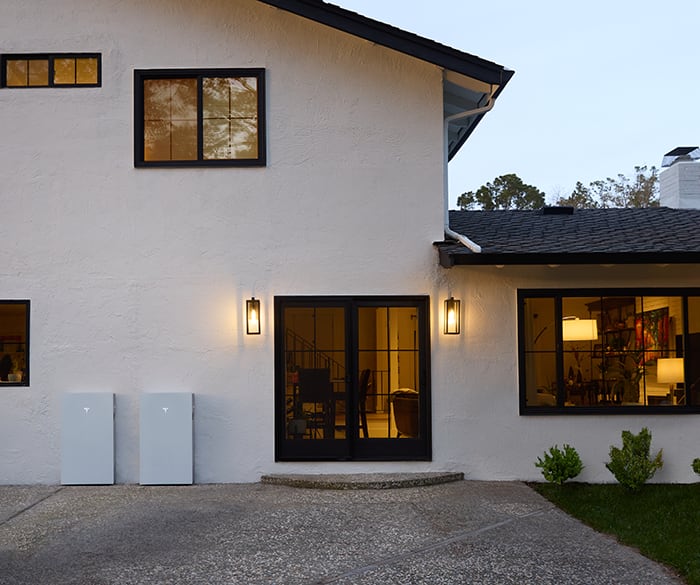
How Do I Know How Much Backup Storage I Need?
Home batteries store electricity from your solar system or the grid for use during outages, when the grid is most expensive, or at night when it is dark. A well-sized system can keep essential appliances running, lower your utility bill and protect you from grid disruptions. Here is how to estimate the right amount of backup battery storage for your home.
Step 1: Know Your Energy Baseline
Energy use is measured in kilowatt-hours (kWh)—the total amount of electricity your home consumes. To estimate your daily usage, take a recent utility bill and divide the total kWh by the number of days in the billing cycle. For example, if you used 900 kWh in 30 days, that’s 30 kWh per day.
Energy usage is often seasonal. Summer air-conditioning or pool pumps push usage sharply higher, while winter electric heating can do the same. It is common for peak-season consumption to exceed your spring or fall baseline. According to the U.S. Energy Information Administration, the median American home used about 10,500 kWh in 2023—approximately 29 kWh per day1. Your actual usage will vary based on your region, home size, and level of electrification (e.g., EVs, heat pumps, induction cooking).
Understanding your historical energy usage gives you a starting point for estimating how long a battery can power your home during an outage.
Step 2: Plan For Outage Length
Battery storage is your energy safety net. Size your system based on how long you want backup power. The average U.S. outage in 2022 lasted 5.5 hours2, but extreme cases like hurricanes can stretch for more than 2 weeks3.
- Short outage (6 hours): Multiply your consumption by the fraction of a day an outage may last.
Example: 12 kWh/day x (6hrs/24hrs in a day = 0.25) = 3 kWh needed. - Multi-day outages (2 days): Multiply daily consumption by number of days.
Example: 12 kWh/day x 2 = 24 kWh needed.
If your solar system can generate electricity during the outage (e.g., fire safety shutoffs in California12), you may need less storage. But during storms or with snow on the roof, assume minimal solar generation.
Step 3: Decide What Is Essential
Not everything needs to run during a power outage. The U.S. Department of Energy (DOE) recommends identifying a limited set of your most critical loads4 – the essentials you want to keep powered:
| Electric Appliance | Typical Daily Use |
|---|---|
| Refrigerator5 | 1.9 kWh |
| Wi-Fi6 | 0.5 kWh |
| 70W of lightbulbs (used for 12 hours)4 | 0.8 kWh |
| Cooking Range5 | 1.4 kWh |
| Well Pump 1hp (used for 2hrs) | 2 kWh |
| Total Critical Energy Load | ~4-6 kWh |
Not running large loads like HVAC, pool pumps, or laundry appliances during an outage means 13.5 kWh of stored energy can run for over 2 days without recharge. However, if during an outage you continue to use large loads, you may need significantly more capacity: typically, 40-90 kWh for 2-3 days of autonomy4.
Step 4: Understand Your Power Needs
While energy (kWh) tells you how long a battery can run, power (kW) determines how many things it can run at the same time. Some batteries offer just 3–5 kW of power—enough for lights, a fridge, and a few other essentials.
| Electric Appliance | Typical Rating |
|---|---|
| Refrigerator5 | 0.8 kW |
| Wi-Fi6 | 0.15 kW |
| 70W of lightbulbs | 0.07 kW |
| Cooking Range7 | 10 kW |
| Microwave11 | 1.2 kW |
| Single speed pool / well pump 1hp | 1 kW |
| Clothes washer8 | 1.2 kW |
| Clothes dryer9 | 6.5 kW |
| 5-ton central air conditioner10 | 5 kW |
| Total Power Load | 25.92 kW |
Example: A Modular Battery System that Scales
Quality home battery systems are modular, which means that you can scale both energy storage capacity and output power based on your needs.
| Example Component | Energy Storage | Power |
|---|---|---|
| Powerwall 3 | 13.5 kWh | 11.5 kW |
| Powerwall 3 Expansion | 13.5 kWh | Shares power from lead unit |
A Sizing Example
If your goal is to cover 5 kWh of most critical loads per day for 2 days of backup autonomy, without any recharge from solar:
- Energy required: 5 kWh × 2 days = 10 kWh
- Power required: 8.22kW
- Solution: A single Powerwall 3 (13.5 kWh, 11.5kW) is enough to cover
Step 5: Pair With Solar Power
Pairing your battery with solar panels does more than provide backup – it can keep your home powered without relying on the grid. When the grid goes down, your solar system can continue generating electricity during the day, powering your home, and recharging your battery simultaneously. This extends backup runtime and moves you closer to full energy independence.
Energy production varies by geographic location. For example, a 5 kW solar system might generate around 20 kWh per day in sunny California, but closer to 12 kWh per day in cloudier regions like Maine. To understand the impact, compare this output to your home’s daily energy use.
Step 6: Think Long-Term
Your energy needs might change over time. Adding an electric vehicle, upgrading to an electric water heater, expanding your household, or installing a pool can all increase your future electricity usage. Planning ahead by sizing your battery slightly larger now can help avoid costly or complex upgrades.
Key Takeaway
Investing in backup storage is a practical step toward a self-sufficient, cleaner energy future. By designing your system thoughtfully and pairing it with solar, you can save on energy costs, reduce your reliance on the grid, and improve the grid’s resilience.
References
1 U.S. Energy Information Administration. How much electricity does an American home use?
https://www.eia.gov/tools/faqs/faq.php?id=97&t=3
2 US Energy Information Administration. U.S. electricity customers averaged five and one-half hours of power interruptions in 2022.
https://www.eia.gov/todayinenergy/detail.php?id=61303
3 NOAA National Hurricane Center, “Tropical Cyclone Report: Hurricane Helene (AL092024),” Mar. 2025, pg23
https://www.nhc.noaa.gov/data/tcr/AL092024_Helene.pdf
4 US Department Of Energy, Lawrence Berkeley National Laboratory. Solar+Storage for Household Back-up Power.
https://emp.lbl.gov/publications/solarstorage-household-back-power,
https://eta-publications.lbl.gov/sites/default/files/year2_pvess_backup_report_v2.pdf
5 US Energy Information Administration, Updated Buildings Sector Appliance and Equipment Costs and Efficiencies Mar 2023.
https://www.eia.gov/analysis/studies/buildings/equipcosts/
6 R. Ayre et al., “Power consumption of Internet infrastructure with PON access,” Optics Express, vol. 20, no. 26, pp. B513–B527, 2012.
https://www.academia.edu/figures/50169052/figure-3-power-consumption-of-internet-infrastructure-with
7 US Environmental Protection Agency, EnergyStar Electric Cooking Products,
https://www.energystar.gov/products/electric_cooking_products,
https://www.energystar.gov/productfinder/product/certified-residential-electric-cooking-products/details/3629220,
https://www.energystar.gov/productfinder/product/certified-residential-electric-cooking-products/details/2687109
8 US Environmental Protection Agency, EnergyStar Electric Clothes Washers,
https://www.energystar.gov/products/clothes_washers,
https://www.lg.com/us/washers-dryers/lg-wt8400cw-top-load-washer
9 US Environmental Protection Agency, EnergyStar Electric Clothes Dryers,
https://www.energystar.gov/products/clothes_dryers,
https://www.lg.com/us/washers-dryers/lg-dle7000w-electric-dryer
10 US Department of Energy. Central Air Conditioning.
https://www.energy.gov/energysaver/central-air-conditioning
11 US Energy Information Administration. Household Appliances.
https://www.eia.gov/consumption/appliances/data/electric-appliance/
12 California Public Utilities Commission. Public Safety Power Shutoffs.
https://www.cpuc.ca.gov/PSPS/