Topics
Energy Support
-
Powerwall
- Learn
- Order
- Install
- Mobile App
-
Owners
- Registering Your Powerwall
- Internet Connectivity
- Best Practices During Power Outages
- Powerwall Calibration
- System Alerts and Notifications
- Connecting to Tesla Gateway
- Get Help and Service for Your Powerwall
- Connecting Your Powerwall With Limited Connectivity
- Troubleshooting
- What to Know About Scheduling Service
- Transferring Ownership of Your Powerwall
- Powerwall 2 Replacement Program
- Documents
- Installer Resources
-
Solar Panels
- Learn
- Going Solar
-
After Installation
- What to Expect After Installation
- Registering Your Tesla Solar Inverter
- Connecting to Tesla Solar Inverter
- Turning On Your System
- Monitoring Your System
- Understanding System Performance
- Troubleshooting Your System
- Get Help and Schedule Service
- What to Know About Scheduling Service
- Billing
- Removal & Reinstallation
- Transferring Ownership of Your Solar System
- Systems Affected by Natural Disaster or Force Majeure Event
- Documents
- Frequently Asked Questions
-
More
- Additional Support
- Legal
Savings Mode
Savings mode (also referred to as load shifting) is an energy optimization mode that can help you maximize savings through smart charging and discharging of your Powerwall. With Savings mode, Powerwall will charge when energy costs from your utility are low and power your home when energy costs are high. This helps minimize your bill and reduce the cost of your total energy usage.
How It Works
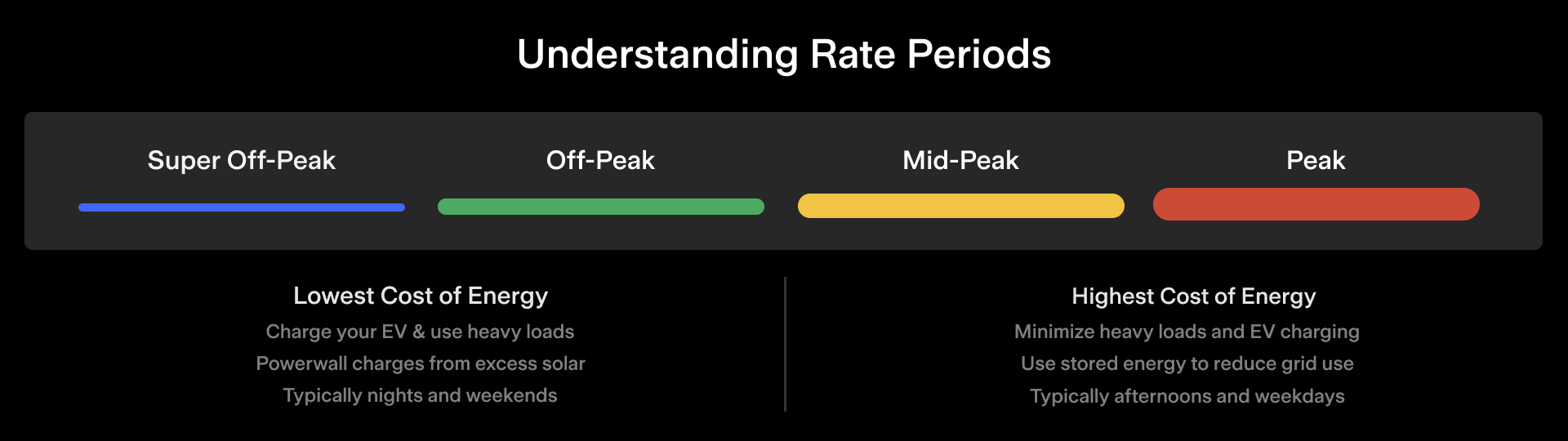
Savings mode uses utility rate structures (also referred to as time-of-use plans) where energy prices may vary depending on the time of day, the day itself, or the season. Time-of-use plans are broken down into the following time periods:
- Peak: High energy demand hours with most expensive prices
- Off-Peak: Low energy demand hours with least expensive prices
- Partial Peak or Shoulder: All other times
When Savings mode is enabled, your Powerwall will begin to charge from and discharge to the grid to take the most advantage of energy prices for different time periods throughout the day. Learn more about the techniques Powerwall uses to optimize performance when in Savings mode.
How to Use It
Once you have set up your utility rate plan, follow these steps to enable Savings mode:
- From the home screen of the Tesla app, open the ‘Settings’ menu.
- Open the ‘Powerwall’ menu.
- Under ‘Operational Mode,’ select ‘Savings.’
- Set your preferred rate plan by tapping the ‘Utility Rate Plan’ card.
- Set your preferred Backup Reserve by adjusting the slider at the top of the screen.
Once enabled, you can monitor the performance of your solar and Powerwall system by reviewing the visuals on the Tesla app home screen and by reviewing the Energy tab.